
I like Edutopia a lot. Their articles are pretty quick, easy reads. I tend to go to them for ideas on behavior management or general trends in assessment, etc, vs World Language specific ideas. In the past year, I’ve started to pay attention to more articles that have “nothing” to do with my content area… such as Math.
The other day I read the article “Using ‘Rolling Starts’ at the Beginning of Class” by Bill Manchester. Although the article was interesting, I gained the most inspiration from a comment made for Math, which shared the website: Which One Doesn’t Belong?
The website is clearly geared towards Math educators (much respect–a job I can’t do for sure), but I see a lot of potential for application in the World Language classroom. I view it as mixing a picture talk with Martina Bex’s “One’s Gotta Go” activity.
The website is broken up into different menu options with different puzzles: Shapes, Numbers, Graphs, and Incomplete Sets. Shapes and numbers puzzles would be an easy way to get some transfer of skills into the classroom as well as some meaningful repetition of, for example, numbers. I often feel like I am looking for better contextual ways to incorporate larger numbers into my classroom… so, maybe this is a good start! Plus, I could use a reason to brush up on fractions and some mathematical thinking, so why not encourage some transferable skills as well with some graphs?
The best part? There are no answers provided to the puzzles. So, open the doors for discussion and LOTS of input. I can see using this in both novice and intermediate level classrooms.
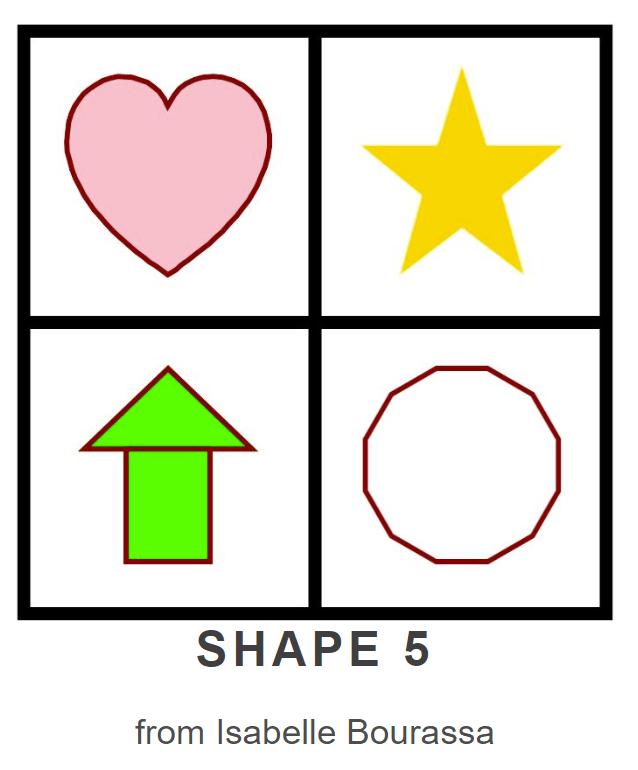
Novice Level: Teacher provides a lot of the input in terms of talking about similarities and differences. I might alter an image to also have the names of the shapes (for example, above) listed in Spanish. Then, after a 3-4 minute explanation of each of the shapes, we vote as a class. “¿Cúal no pertenece?” I’m thinking that sounds like a solid bellringer, no?
Intermediate Level: Teacher still provides lots of input, but potentially some sentence starters could be provided for a fuller discussion and thus, a debate that lasts a bit longer than the 3-4 minute novice activity. This would still be a great bellringer, and I would still likely call for a class vote, but there is a lot of opportunity here for interpersonal communication.
I look forward to trying this out! Have you heard of this website (either Math or WL educators?) and used it in your classes? Share some tips if you have!



 CIspanish.com
Leave a comment