
At my new school, I have an amazing colleague that does a fantastic job at building community via routines in her classroom. This has pushed me to try out new things that work with my personality and work for my students. Sometimes, when I try out new routines, I find that they fizzle or just don’t work in my classroom. However, this year–I found one that both my students and I fell in love with: La persona misteriosa!
La persona misteriosa (the mysterious person): I got this idea from a Facebook group thanks to a comment made by, I believe, Spanish teacher and Cuéntame podcast host Marta Ruiz Yedinak… The original FB post was asking about alternatives to Special Person Interviews or Star of the Week and that piqued my interest. At that point in the year (it was probably late September), I felt like interest was already waning with Special Person Interviews and I didn’t exactly like the feeling of putting students on the spot to answer simple questions, even if I provided lots of support and scaffolding. And voilá, I saw Marta’s suggestion of the Mysterious Person and ran with it! *Right before publishing this, I did a google search and also found this blog post on the Spanish Brew! Thanks to them as well, if they were the originators!
- Here’s how I have rolled out La persona misteriosa:
- Students, before they even knew what it was for, filled out this simple form with sentence starters in English. I print it out 2 pages per sheet so I save paper.
- Once a week, I “select” (meaning I just take the next paper) a new mysterious person before school starts. I number the sentences in the margins from 1 through 8, for example, starting with the most general statement (The mysterious person’s favorite food is pizza. // The mysterious person’s favorite possession is their phone) to the most specific (If the mysterious person could wake up tomorrow with a new ability, it would be to speak Italian fluently — I have a student who is vocal about wanting to move to Italy!). I do this, of course, in the TL.
- Before class, I make a note of any new/low frequency vocabulary for them and write it on the board in Spanish. I fill in the English meaning on the board as I talk through the sentences.
- Every Friday, students know there will be a new “persona misteriosa”. They grab white boards, but leave them on the floor. I do not allow them to have them on their person during the provided input. No distractions, please!
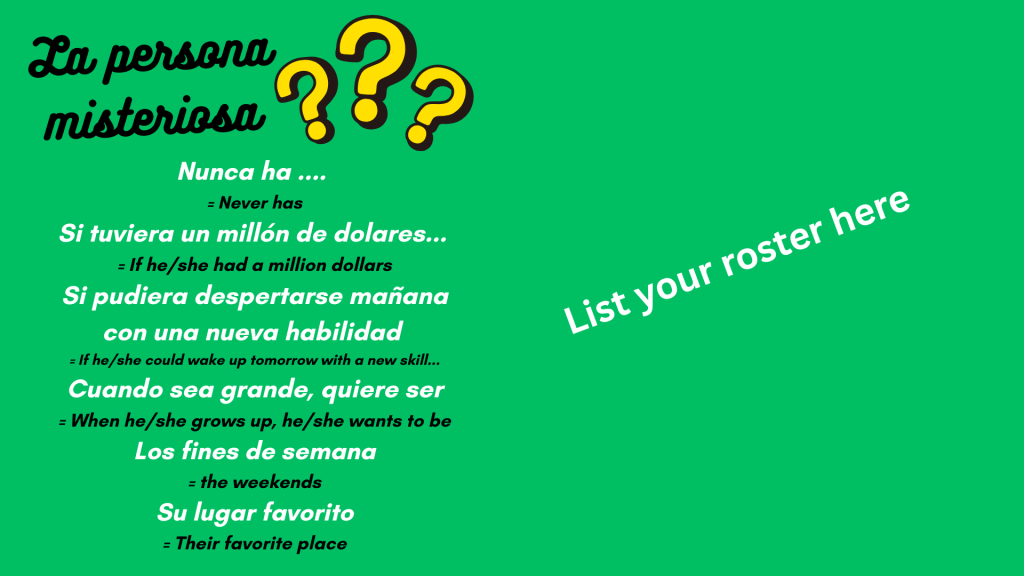
- I have the roster projected along with comprehension supports for the tougher statements (If the mysterious person could wake up tomorrow with a new skill… // When the mysterious person grows up, they want to be…).
- I warn them not to expose the mysterious person if they know who it is (or if it is themselves).
- Once I’ve read all the sentences about the mysterious person, they grab their whiteboards and make a guess by writing down a name. Sometimes it’s obvious, sometimes it’s not!
- But that’s not it — milk the input for all you can! Once students have written a name down…
- If there are a few guesses to who the mysterious person is, do PQA with those different students… build it up to revealing who the mysterious person is. I ask the questions that are the most generic first to a bunch of the guessed people, “Is your favorite possession your phone? What’s your favorite app?” // “Is your favorite food tacos? What kind?”
- If the mysterious person is OBVIOUS, I don’t give up and just say, “Yep, it’s them!” I instead confuse the heck out of students when I say, “Wow, it looks like everyone thinks it’s Evan (when in fact, no one wrote Evan). Evan, if you had a million dollares, would you…?” Then finally, I’ll give in and ask the actual mysterious person a bunch of questions so we can confirm *for sure* it’s them!
- Why students love it: They LOVE to be the mysterious person. People, generally, love being made to feel special and even if the student is on the more timid side, they are the center of attention for a split second only when their name is revealed. For extroverted students, I can milk it more with additional questions about their answers.
- Bonus: When they are the mysterious person, they get to sit in my comfy chairs with a classmate/friend every day during the following week. This would still work if you didn’t have comfy chairs–that’s just a perk. I would suggest a piece of candy, class swag, or some sort of perk to give to them.
- Why I love it:
- Compelling input that keeps them tuned in. It also allows me shelter new vocabulary appropriately and unshelter grammar. Yes, my students have been exposed frequently to the subjunctive, present perfect, and conditional and they understand it because it’s used in context!
- It works on all levels. This past year, I did it in Spanish 2 and 3 (I teach Spanish 4 and AP too). Next year, I’ll do it with my new group of 2s and start out a new community building routine next year with my 3s. Stay tuned in August.
- It builds so much community! Not only among students, but also allows me to get to know them. Since I’m at a new school, that has been extra important to me. I have since learned one of my students has 2 cats, but when he grows up he wants five cats, haha! I’ve learned that another student’s secret talent is making (quite accurate) bird noises! What gems of knowledge 🙂
- Lastly, everyone gets a turn! If you have more kids in your class than you have weeks in the year/semester, consider doing two personas misteriosas!
- Ideas moving forward: I’m reflecting on how I can use the information we’ve learned about each other in other ways… summaries of students (reading input!) and matching to their names as a gallery walk style strategy? In order for this to happen, maybe a write and discuss always afterwards? Still thinking. If you have ideas, please share!
Let me know if you do this in your classroom now or decide to try it out for next year! I would love to hear how it goes.




Leave a Reply